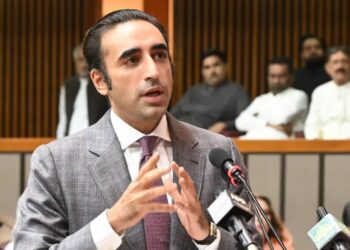


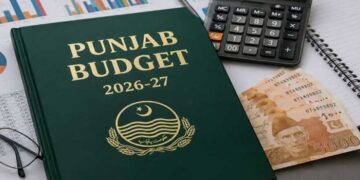




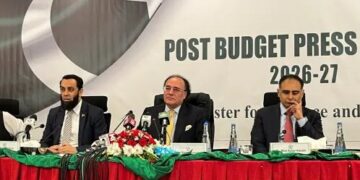
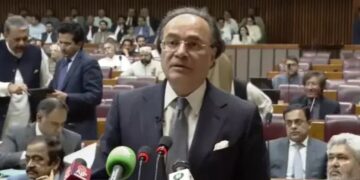






















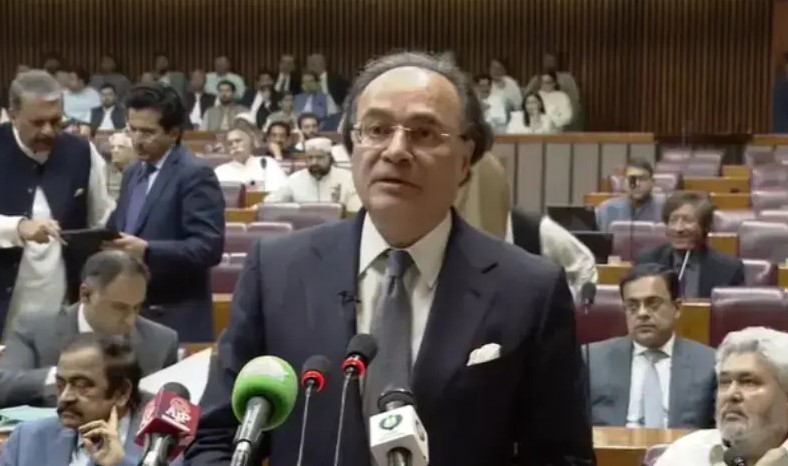
ISLAMABAD (MNM); Finance Minister Muhammad Aurangzeb presented Pakistan’s Rs18.8 trillion federal budget for fiscal year 2026-27 in the National Assembly on Friday during a session marked by strong opposition protests and political tensions.
The budget session, chaired by Ayaz Sadiq, began nearly two hours behind schedule. Opposition lawmakers, mainly from Pakistan Tehreek-e-Insaf, staged loud demonstrations throughout the proceedings, chanting slogans and displaying placards against the government.
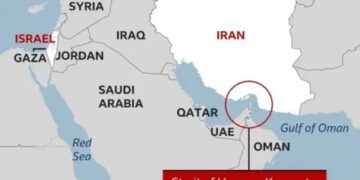
Before unveiling the budget proposals, Aurangzeb thanked coalition partners for supporting the government and highlighted Pakistan’s growing international standing. He linked the country’s diplomatic and strategic gains to developments following Operation Bunyan-um-Marsoos and Pakistan’s role in facilitating regional peace efforts during recent tensions involving Iran and the United States.
The finance minister credited Prime Minister Shehbaz Sharif for taking timely decisions that helped shield the economy from the fallout of regional conflicts, including preventing fuel shortages and economic instability.
Reviewing the government’s economic agenda, Aurangzeb reiterated plans to privatise several state-owned entities, including power generation and distribution companies, banks, insurance firms and airports. He also announced reforms within the Federal Board of Revenue (FBR), describing them as essential for building a self-reliant economy.
According to the minister, the budget has been designed around increasing industrial productivity and boosting exports. Tax incentives have been proposed for major industries, while exporters will continue receiving support through the Export Financing Scheme. The government also plans to expand financing facilities for farmers, recognising agriculture as a key pillar of the national economy.
Aurangzeb said the government intends to increase revenue collection through improved enforcement and compliance rather than imposing additional taxes on citizens. He added that significant reforms in the FBR would strengthen tax administration.
Due to regional uncertainties and national security considerations, the government has substantially increased defence spending. The defence allocation for FY2026-27 has been fixed at Rs3 trillion.
Presenting the fiscal framework, the finance minister said the economy is projected to grow by 4 per cent during the coming fiscal year, while average inflation is expected to remain around 8.2 per cent. The government aims to keep the fiscal deficit at 3.6 per cent of GDP while targeting a primary surplus of 2 per cent.
Total tax revenue is projected at Rs15.264 trillion, representing an increase of 17.6 per cent compared to the outgoing fiscal year. Of this amount, Rs8.848 trillion will be transferred to provinces under the National Finance Commission framework.
Aurangzeb also announced a new revenue-sharing mechanism agreed upon by federal and provincial governments to jointly finance strategic national priorities. Under the arrangement, provinces will return a portion of their share from the federal divisible pool as grants under Article 164 of the Constitution to support national projects and requirements.
The minister stressed that the mechanism was developed through cooperative federalism and would not affect the constitutional rights of provinces. Similar arrangements may continue during fiscal years 2027-28 and 2028-29 after consultation with provincial governments.
Federal non-tax revenues are estimated at Rs5.336 trillion, while net federal revenues are expected to reach Rs11.751 trillion.
For development spending, the government has allocated Rs1 trillion for the federal Public Sector Development Programme. Including allocations for public-private partnerships and state-owned enterprises, total development spending will rise to Rs1.451 trillion.
Provincial development schemes have been allocated Rs2.224 trillion, while Rs451 billion has been earmarked for investments by state-owned enterprises.
Aurangzeb said the distribution reflects responsibilities outlined under the 18th Constitutional Amendment, under which provinces manage most social-sector services while the federal government focuses on strategic national projects.
Current federal expenditure has been estimated at Rs17.495 trillion. The government has allocated Rs8.045 trillion for debt servicing, Rs1.169 trillion for pensions, Rs1.091 trillion for subsidies and Rs1.071 trillion for civil administration expenses.
An allocation of Rs2.680 trillion has been made for the Benazir Income Support Programme, Azad Jammu and Kashmir, Gilgit-Baltistan and the merged districts of Khyber Pakhtunkhwa.
The finance minister also announced tax relief measures for salaried individuals and businesses. Income tax rates have been reduced across four upper income slabs, while the 9 per cent surcharge on salaried individuals will be abolished.
The government has further proposed eliminating super tax on businesses earning between Rs150 million and Rs500 million annually. For companies earning above Rs500 million, the super tax rate will be reduced from 10 per cent to 8 per cent.
Aurangzeb announced plans to abolish taxes on sanitary pads and contraceptives. Government employees will receive a 7 per cent salary increase, while pensioners are set to receive a 7 per cent pension raise. The minimum wage has also been proposed to increase by 10 per cent.
Reviewing economic performance, the minister stated that Pakistan’s GDP growth reached 3.7 per cent during the outgoing fiscal year. Large-scale manufacturing expanded by 6.1 per cent while the services sector recorded growth of 4.1 per cent, the highest in four years.
He said Pakistan’s economy had expanded to $452 billion, while per capita income increased to $1,901 from $1,751 a year earlier. Foreign exchange reserves rose to $17 billion from only $4 billion three years ago, providing approximately three months of import cover.
Remittances reached $38 billion during the first eleven months of the fiscal year and are expected to surpass $41 billion by year-end, potentially setting a new national record.
Aurangzeb also highlighted progress in tax collection, noting that annual FBR revenues have nearly doubled over the past three years and are expected to reach Rs13 trillion by the end of the current fiscal year.
The budget session witnessed intense political activity. PTI lawmakers chanted slogans against the government and held placards demanding the release of former prime minister Imran Khan. Some lawmakers tore copies of the budget documents and threw them towards the treasury benches.
A brief scuffle also erupted between PTI lawmaker Shahid Khattak and treasury members, prompting intervention by security personnel.
Meanwhile, coalition partner Pakistan Peoples Party staged its own protest over water distribution issues affecting Sindh. PPP lawmakers, including Shazia Marri, demanded a greater provincial water share and accused authorities of unfair reductions in water allocations.
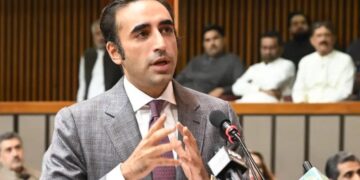
Although reports initially suggested a boycott, PPP later clarified that it would participate in the budget process in the national interest. Party Chairman Bilawal Bhutto Zardari held consultations with government leaders before the budget presentation.
The budget now moves to parliamentary debate, where lawmakers from both government and opposition benches are expected to scrutinise the proposals before final approval.