































By Aleeza Nadeem
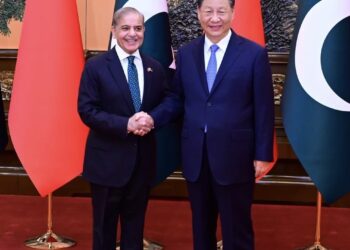
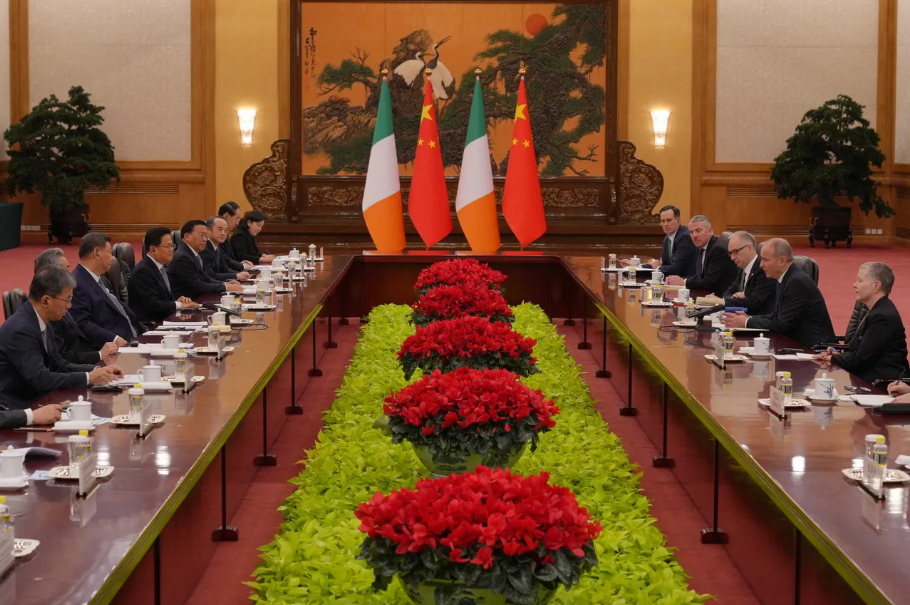
In a recent development, China is keen on fostering its bilateral relations and enhancing collaboration in multiple fields with Ireland, seeing it as a door to unlock potential opportunities to mend its relations with the European Union. In his opening remarks at a meeting with Prime Minister Martin Micheal at the Great Hall of Fame in Beijing, XI Jinping said that ‘’China is willing to strengthen economic and trade cooperation with Ireland, share opportunities and pursue common development, state news agency Xinhua reported. Irish Taoiseach Micheál Martin also praised China’s contribution to the UN, especially their peacekeeping efforts, while also stating that Ireland is committed to fully liberalizing its trade.
Due to the current tensions between the EU and China, Martin’s trip is of significant importance. China is the main source of contention between Ireland and the EU. In 2025, Beijing began imposing provisional tariffs that reached as high as 42.7% on dairy products imported from the EU. China’s Ministry of Commerce justified its tariffs on the EU by stating that the EU’s subsidies have negatively impacted China’s dairy industry. The series of tariffs is widely seen as a retaliatory move by China after the EU targeted Chinese electric vehicles with duties.
Despite this backdrop, China’s invitation and Ireland’s acceptance are perceived as an Intelligent move of Beijing to engage individual EU members to heal its fragmented relations with the European Union. By bolstering bilateral relations, China seeks to utilize economic linkages to mitigate the political friction with Brussels. China draws its attention to cooperating with Ireland in multiple fields, including artificial intelligence, digital economy, pharmaceuticals, and tourism, reflecting its attitude to engage in multilateral diplomacy.
For Ireland, the visit is significant and unlocked vast opportunities to sustain its economic interests and promote open trade. Prime Minister Martin acknowledged the international role of China in global affairs, reflecting Dublin’s historical approach of global interdependence. He said, “In the modern world, engagement is still key irrespective of the particular policy decisions or initiatives that are taken from time to time by individual countries. So, in other words, Ireland has always been international since our independence.
Ireland is a big supplier of beef, dairy products and has expertise in the agrifood, information, and technology sectors, while China has a big market economy and has a comprehensive industrial chain. This visit is expected to bring new opportunities for bilateral trade and investment. On the other hand, experts have a firm belief that Dublin’s policy of enhancing bilateral trade with China does not come at the cost of undermining the EU position. Ireland holds a tradition of neutrality within the EU, often playing the role of a coordinator. This dual role is partly enabled due to Ireland’s openness and symbolic visits to China and its economic interdependence with global markets.
Recently, public support for close ties between China and the European Union has significantly increased. The European Tech Insights 2025 survey, conducted by IE University’s Center for the Governance of Change in Spain, found that 29% of Europeans now prefer to side with China, which was previously 14% in 2023. This change comes at a time when Europe is 15 percent tariff on most of its goods entering the US, energy insecurity, and policy disagreements. US-EU relations faced a new friction over the strict export control on technology and disagreements on defense spending. With the EU considering the tariffs on imported dairy products a form of aggressive protectionism, China has used this opportunity to extend its trade and diplomatic relations with the EU. China has also expanded its trade with Ireland. With the current European focus on Germany and China’s expanding bilateral trade (which is expected to exceed 185.9 billion euros, or 219.2 billion U.S. dollars, by the end of the 2025), Martin’s visit indicates the importance China is placing on its relations with Ireland.
However, deep disagreements between China and Europe over human rights, governance, and economic models clearly limit their growing engagements. Global events further complicate the whole scenario: the latest U.S strikes on Venezuela, the Ukraine-Russia War, and the reshaping of international alliances. Ultimately, China’s strategy of engaging Europe through bilateral relationships may ease tensions at the margins, but lasting improvement in China–EU relations will depend on whether Beijing can address Europe’s structural concerns rather than relying only on diplomatic outreach.
The author is a multimedia journalist and digital strategist associated with Diplomatic Affairs, covering geopolitics, conflict, and human rights. Her work blends investigative reporting with data-driven storytelling, uncovering voices from regions often ignored by mainstream media. She can be reached at aleezashaikh92@gmail.com
Disclaimer: “The views and opinions expressed in this article are solely those of the author and do not necessarily reflect the official policy of any organization”.