

























































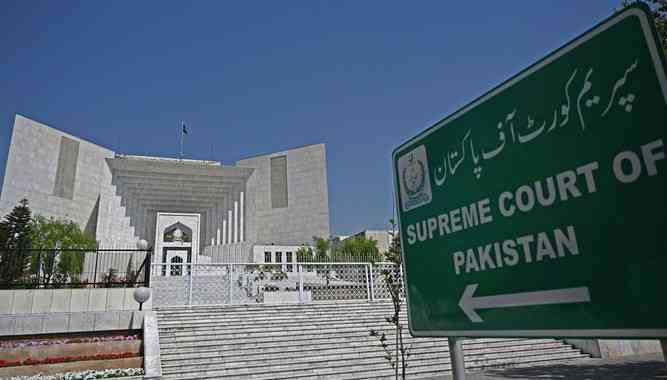
ISLAMABAD (MNN); The Supreme Court of Pakistan on Thursday reserved its verdict on a key constitutional question regarding whether it retains jurisdiction to hear bail applications in pending National Accountability Bureau (NAB) cases or whether such matters now fall under the authority of the Federal Constitutional Court (FCC) following the 27th Constitutional Amendment.
A three-member bench headed by Justice Muhammad Ali Mazhar, and comprising Justice Musarrat Hilali and Justice Shahid Bilal Hassan, concluded proceedings after hearing detailed arguments from both sides. The bench indicated that its ruling is expected within the next few days.
The case concerns whether bail applications in pending NAB appeals should be transferred to the Federal Constitutional Court, which was established under the 27th Constitutional Amendment as the designated appellate forum for certain constitutional matters.
The federal government argued that both appeals and bail applications in pending NAB cases now fall within the jurisdiction of the FCC.
Representing under-trial prisoner Aamir Mahmood, senior lawyer Ibadur Rehman Lodhi contended that bail applications filed by under-trial prisoners are governed by Section 497 of the Criminal Procedure Code (CrPC), which deals with the grant of bail, and are distinct from Section 426, which relates to the suspension of sentence after conviction.
He argued that Section 32-A of the National Accountability Ordinance, introduced through the NAB Amendment Act on March 5, provides for second appeals against convictions handed down by high courts and does not apply to bail matters. Therefore, he maintained, the Supreme Court remains competent to hear bail petitions under Section 32 of the NAB law.
During the hearing, Justice Muhammad Ali Mazhar observed that the court was not examining Parliament’s intent behind the amendments but rather determining the legal forum for hearing such applications.
“The Supreme Court has not surrendered its authority; however, the 27th Constitutional Amendment provides that appeals shall be heard by the Federal Constitutional Court,” Justice Mazhar remarked.
The judge questioned how the Supreme Court could continue functioning as an appellate authority in bail matters if the amended NAB law had designated the FCC as the appellate forum.
Responding to the bench, Advocate Lodhi urged the court not to relinquish its constitutional jurisdiction, arguing that the Supreme Court should retain authority over bail applications while appeals against final high court judgments could proceed before the FCC.
Justice Mazhar also questioned whether converting bail petitions into appeals would effectively make the Supreme Court an appellate court under the amended legal framework.
The counsel maintained that the NAB Amendment Act specifically refers to “appeals” and makes no mention of bail applications, arguing that the FCC had only been vested with jurisdiction over appeals against high court decisions.
Referring to Article 199 of the Constitution, Justice Mazhar asked whether any judicial precedent existed where the Supreme Court exercised jurisdiction despite not being the designated appellate forum.
Attorney General for Pakistan Mansoor Usman Awan submitted that the Supreme Court had, in previous cases, examined the merits of bail petitions in detail, including in the case involving former federal minister Khawaja Saad Rafique.
After hearing arguments from all parties, the bench reserved its judgment, which is expected to clarify the jurisdictional boundaries between the Supreme Court and the newly established Federal Constitutional Court in NAB-related proceedings.