








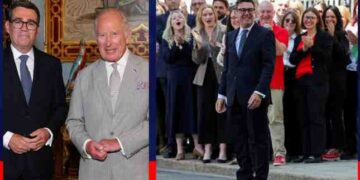























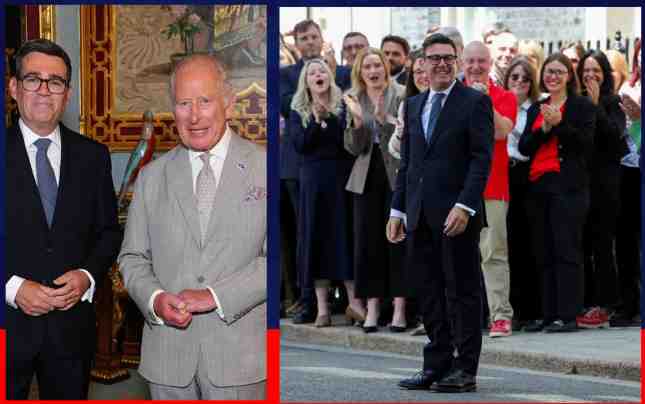
LONDON (MNN); Britain entered a new political chapter on Monday as King Charles III formally appointed Andy Burnham as the country’s new Prime Minister following the resignation of Keir Starmer.
Buckingham Palace confirmed that Burnham accepted the King’s invitation to form a new government after Starmer officially submitted his resignation. The ceremonial appointment marks another leadership transition for Britain, making Burnham the sixth prime minister to occupy 10 Downing Street in the past decade.
Shortly after assuming office, Burnham delivered his first address outside Downing Street to a large gathering of supporters, pledging to restore economic confidence, political stability and public trust.
He announced that his government would unveil immediate measures this week to ease the cost-of-living crisis, followed later this year by a comprehensive 10-year national development strategy.
“Britain needs to show the world that we can regain our stability once again,” Burnham said, acknowledging that the country must perform better economically and socially.
The new prime minister promised to expand employment opportunities for young people through education reforms, increased mental health support and the construction of additional council housing. He said these policies would help reduce welfare spending while maintaining fiscal discipline and honouring Britain’s defence commitments to international allies.
Burnham succeeds Keir Starmer just two years after Labour secured a historic general election victory that ended 14 years of Conservative rule. His appointment follows Starmer’s decision to step down after months of political setbacks, policy reversals and declining public support.
During his first day in office, Burnham said his earliest international phone calls would be to US President Donald Trump and Ukrainian President Volodymyr Zelensky, reaffirming that Britain’s support for Ukraine would remain “steadfast and resolute.”
He stressed that there would be “no change whatsoever” in London’s political and defence backing for Kyiv and pledged his personal commitment to maintaining close cooperation with President Zelensky.
Meanwhile, Britain’s Finance Minister Rachel Reeves announced her departure from government, expressing full support for Burnham and wishing success to the incoming administration. Attention has now shifted to Burnham’s expected cabinet appointments, particularly the selection of a new Chancellor responsible for steering Britain’s economy through challenging times.
Often referred to as the “King of the North” due to his successful tenure as Mayor of Greater Manchester, Burnham returns to national leadership with a reputation for practical governance and regional development. Labour lawmakers view him as the party’s strongest figure to counter the growing popularity of Nigel Farage’s Reform UK party.
In his farewell address, Keir Starmer defended his record, saying his government had left Britain “stronger and fairer” than when it entered office, adding that he departed with pride in his administration’s achievements.
World leaders swiftly congratulated Britain’s new prime minister.
President Asif Ali Zardari expressed hope that Pakistan and the United Kingdom would further strengthen their longstanding partnership under Burnham’s leadership. He reaffirmed Pakistan’s commitment to diplomacy and peaceful conflict resolution while expressing optimism that Britain would support renewed efforts to restore dialogue between the United States and Iran under the Islamabad Memorandum of Understanding.
Prime Minister Shehbaz Sharif also extended his congratulations, saying he looked forward to working closely with Burnham to deepen bilateral cooperation, particularly in trade, investment and people-to-people ties strengthened by the British Pakistani community.
European Commission President Ursula von der Leyen and European Council President Antonio Costa welcomed Burnham’s appointment, expressing hope that recent improvements in EU-UK relations would continue and expand.
Ukrainian President Volodymyr Zelensky congratulated Burnham and thanked Britain for its unwavering political and defence support, saying he looked forward to continued close cooperation.
Burnham has outlined an ambitious reform agenda aimed at ending years of political instability. He has promised a new approach to public spending, focusing on early investment, prevention and long-term economic growth rather than increased expenditure on social crises.
Among his immediate challenges are sluggish economic growth, rising public debt, elevated borrowing costs, inflationary pressures, irregular migration, and uncertainty created by continuing tensions in the Middle East and volatile global energy markets.
His first major policy decision came even before taking office, when he announced the cancellation of Labour’s proposed nationwide digital identity programme, valued at approximately £1.8 billion. The government said those funds would instead be redirected towards measures designed to ease pressure on household finances and improve essential public services.
With a general election expected in 2029, Burnham now faces the difficult task of delivering meaningful economic improvements while rebuilding public confidence in Labour’s leadership.