


























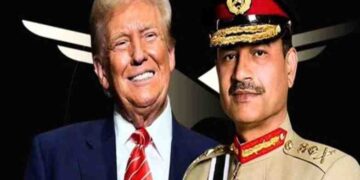








WASHINGTON/ISLAMABAD (MNN); US President Donald Trump on Monday warned Iran of severe consequences for any future attacks on American forces, declaring that every American soldier killed would be avenged with an overwhelming military response.
In a message posted on social media, President Trump said, “Every time Iran kills an American soldier, they will pay for that killing many times over.” He added that the directive had already been conveyed to Defence Secretary Pete Hegseth, Chairman of the Joint Chiefs of Staff General Dan Caine, and other senior US military commanders, although he did not disclose any operational details.
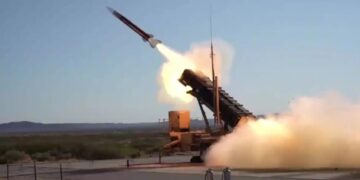
The warning came as the United States launched its tenth consecutive night of military strikes against Iranian targets, continuing an expanded air campaign aimed at weakening Tehran’s military capabilities and restoring freedom of navigation through the strategically vital Strait of Hormuz.
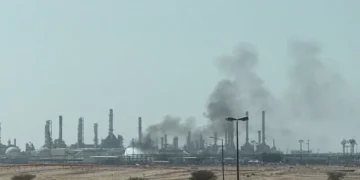
According to US Central Command (CENTCOM), the latest operations targeted military infrastructure used by Iran to threaten commercial shipping in the Gulf.
The renewed military escalation follows the deaths of 17 American service members since the conflict began.
The US military confirmed that two American soldiers were killed in Jordan on Friday while defending against Iranian ballistic missile and drone attacks on a military installation. A third service member remains missing following the assault.
Separately, another American soldier died in northern Iraq during the controlled detonation of unexploded Iranian military ordnance recovered from a downed drone.
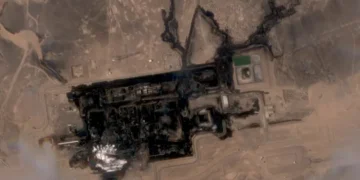
The conflict has entered its second consecutive week, with US forces expanding strikes beyond southern Iran to include bridges, electrical infrastructure and locations believed to house underground missile facilities.
Iran responded by launching fresh missile and drone attacks targeting several American allies across the Gulf region.
Authorities in Jordan announced that their armed forces intercepted three Iranian missiles on Monday evening, preventing casualties or material damage.
Meanwhile, Bahrain activated nationwide air raid sirens after reporting incoming missile and drone threats. Bahrain’s Foreign Ministry also condemned Iranian drone attacks targeting the country’s air navigation systems, warning that such actions endangered civilian aviation.
In Kuwait, military officials confirmed that air defence systems intercepted incoming Iranian projectiles targeting areas hosting US military facilities.
The maritime security situation also deteriorated further.
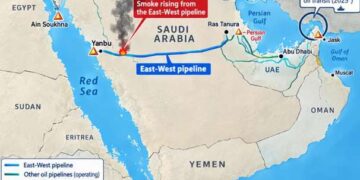
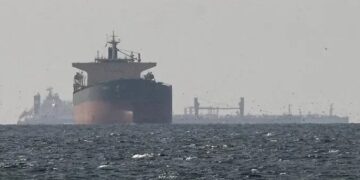
The United Kingdom Maritime Trade Operations (UKMTO) reported that a second commercial vessel was attacked in the Strait of Hormuz, this time off the coast of the United Arab Emirates.
Earlier, another merchant ship caught fire after being struck by a projectile near Oman’s coastline. The crew abandoned the burning vessel, which remained adrift for several hours.
The attacks came despite efforts by the US Navy to redirect commercial shipping through safer routes around Oman to reduce exposure to escalating hostilities in the Strait of Hormuz.
While military operations continue, President Trump also signed an executive order aimed at strengthening America’s defence industrial base.
The order requires Pentagon contractors, beginning in 2027, to provide detailed justification whenever domestic materials cannot be sourced within the United States. Defence suppliers will also be required to map critical supply chains from raw materials to finished military equipment in an effort to reduce dependence on foreign manufacturing.
Meanwhile, White House Press Secretary Karoline Leavitt confirmed that President Trump will travel to Dover Air Force Base on Tuesday to attend the dignified transfer ceremony honouring the American service members killed during the conflict.
“The President and the entire White House are praying for their families,” she said.
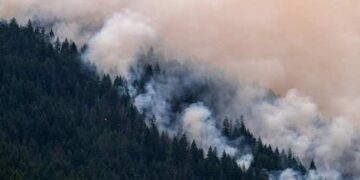
Separately, Trump also commented on Canada’s ongoing wildfire crisis following discussions with Canadian Prime Minister Mark Carney during Sunday’s FIFA World Cup final in New Jersey.
The US president urged Canada to intensify efforts to control forest fires, claiming smoke from the blazes had affected American air quality. He suggested that Canada should consider compensation or face possible tariff measures if the situation continues.
The widening military conflict, increasing attacks on international shipping and continued disruption around the Strait of Hormuz have heightened concerns over regional stability, global energy security and the risk of a broader Middle East war.